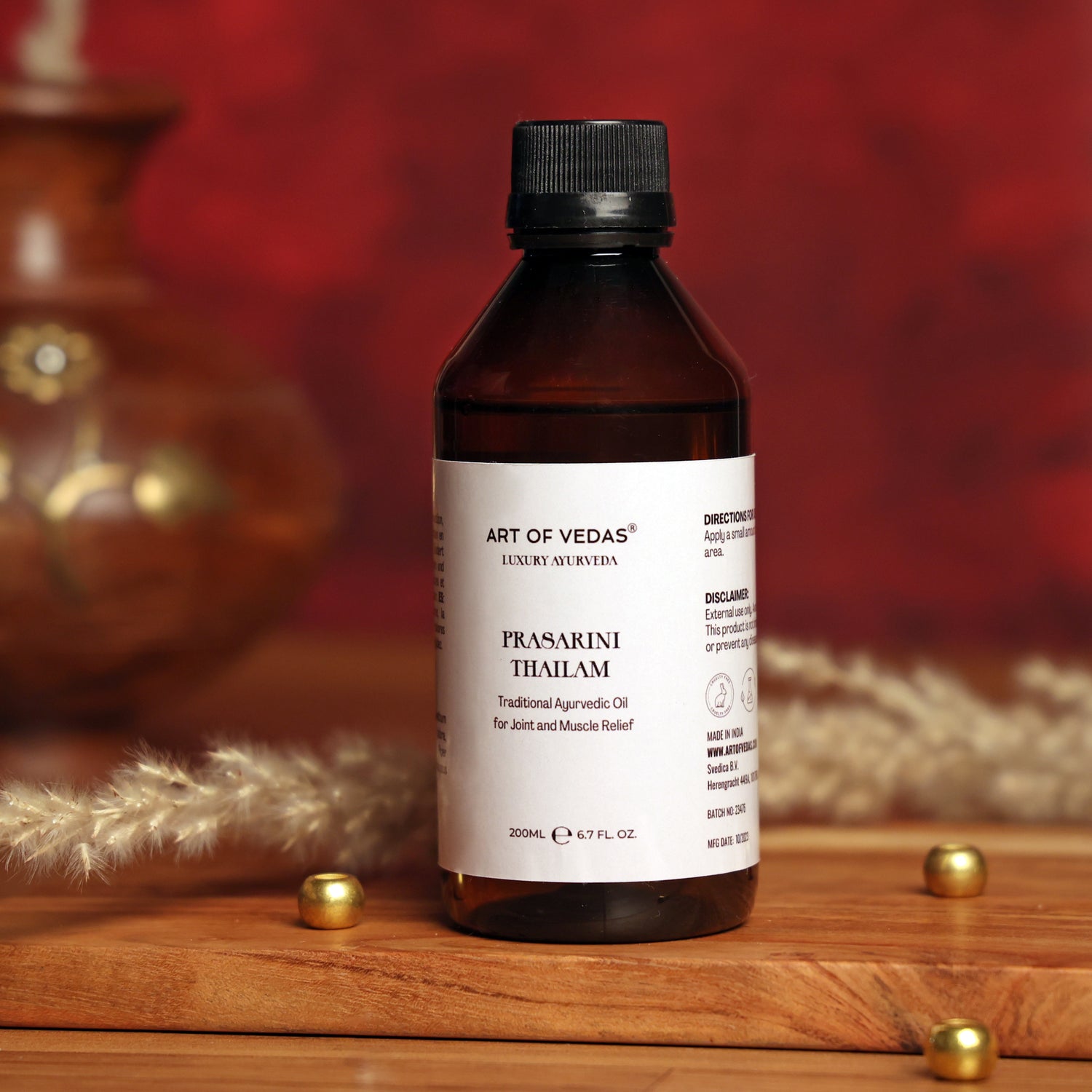








Prasarini Thailam

(3)

Classical Ayurvedic Oil for Joint Stiffness & Muscle Comfort

€18,00

Prasarini Thailam is een klassieke Ayurvedische olie die speciaal is samengesteld om de gewrichtsmobiliteit te ondersteunen, spierstijfheid te verlichten en comfort te bevorderen in het bewegingsapparaat. Vermeld in de Sharangdhara Samhita, combineert deze traditionele formule 13 Ayurvedische kruiden in een sesamoliebasis, verwerkt met gefermenteerde graanvloeistof (Dhanyamla) en yoghurt voor verbeterde opname en effectiviteit.

De formulering is opgebouwd rond Prasarini (Paederia foetida), een kruid waarvan de Sanskrietnaam "dat wat zich verspreidt" betekent, verwijzend naar het traditionele vermogen om diep door te dringen in stijve, samengekrompen weefsels. Gecombineerd met verwarmende kruiden zoals Devadaru (Himalaya-ceder), Chitraka (Leidkruid) en de versterkende eigenschappen van Laksha (Lac), biedt deze olie gerichte ondersteuning voor mensen die gewrichtsongemak, spierspanning en algemene stijfheid ervaren—vooral wanneer dit verband houdt met een Vata-ongelijkheid.

Netto Inhoud

INGREDIËNTEN

Lac, gefermenteerde graanvloeistof, sesamolie, Anethum Sowa, Cedrus Deodara, Glycyrrhiza Glabra, Paedaria foetida, Plumbago zeylanica, Piper officedinarum, rotszout, yoghurt, scindapsus officinalis, semicarium anacard.

Prasarini Thailam

€18,00

€18,00

Prasarani Thailam - Ayurvedic Herbal Oil and Thailam by Art of Vedas. Shop Online.

Prasarini Thailam: verlichting voor gewrichten en spieren

Prasarini Thailam holds a unique position among Ayurvedic oils. While many Thailams address general Vata imbalance, Prasarini Thailam was specifically developed for conditions where stiffness, rigidity, and restricted movement predominate. Documented in the Sharangdhara Samhita, one of Ayurveda's most respected pharmaceutical texts, this formula has been used for centuries to support those experiencing joint limitations, muscle tightness, and reduced flexibility.

In Ayurveda, joints and muscles are primary sites of Vata dosha. When Vata becomes aggravated, these tissues can become dry, cold, stiff, and uncomfortable. Prasarini Thailam addresses this through a carefully balanced combination of warming, penetrating, and nourishing herbs that work together to restore comfort and ease of movement.

The Foundation: Prasarini (Paederia foetida)

The formulation takes its name from Prasarini, a climbing vine that grows throughout the Himalayas and across India. The Sanskrit name "Prasarini" derives from "prasarana," meaning spreading or extending—a name that perfectly describes this herb's unique therapeutic quality.

In classical Ayurvedic understanding, Prasarini has a special ability to "spread" into contracted, stiff tissues, helping to restore their natural flexibility. This spreading quality (Sara Guna) is considered the herb's defining characteristic and the reason it was chosen as the primary ingredient for this formulation.

Prasarini is traditionally valued for:

  • Its warming nature that counters cold, stiff tissues
  • Its penetrating quality that reaches deep into muscles and joints
  • Its ability to support comfortable movement
  • Its grounding, strengthening effect on the body

Hoe Prasarini Thailam te gebruiken

  1. Warm the Oil: Heat a small amount of Prasarini Thailam gently until it is slightly warm to touch, enhancing its penetration and effectiveness.
  2. Apply Gently: Massage the oil into the affected areas, focusing on joints and muscles where pain and stiffness are prevalent.
  3. Massage Techniques: Use circular motions for joints and long strokes for muscles to help the oil penetrate deeper and stimulate circulation.
  4. Rest Period: Allow the oil to absorb into the skin for at least 30 minutes; overnight application can maximize benefits.
  5. Wash Off: Optionally, you can wash off the oil with warm water if needed after the rest period.

Klassieke Ayurveda Referentie

Prasarini Thailam is documented in several authoritative Ayurvedic texts:

Sharangdhara Samhita (Madhyama Khanda, Chapter 9, Verses 119-123.5) — The primary classical reference, appearing in the Taila Prakarana (chapter on medicated oils). This 13th-century text is one of Ayurveda's most important pharmaceutical references.

Bhaishajya Ratnavali (Vatavyadhi Adhikara) — Lists Prasarini Thailam among formulations for Vata disorders. Also describes Maharaja Prasarini Thailam, an enhanced variant.

Sahasrayogam (Taila Prakarana) — The Kerala compendium of formulations includes this oil in its collection of traditional Thailams.

Yoga Ratnakara — Another classical text referencing Prasarini formulations.

Ayurvedic Formulary of India, Volume 1 — The modern official reference containing the standardised formula.

Sanskrit Name and Etymology

Sanskrit: प्रसारिणी तैलम् (Prasāriṇī Tailam)

Breakdown:

  • प्रसारिणी (Prasāriṇī) — from "prasaraṇa" meaning spreading, extending, dispersing
  • तैलम् (Tailam) — oil, specifically medicated oil

The name carries dual significance: it describes both the climbing, spreading growth habit of the Prasarini plant and its therapeutic action of "spreading" into contracted, stiff tissues to restore flexibility and ease.

The plant is also known as Gandha Prasarini ("that which spreads smell") due to its characteristic sulfurous odour when fresh.

Classical Indications

The Sharangdhara Samhita lists Prasarini Thailam for:

  • Hanustambha — Locked jaw, jaw stiffness
  • Katishoola — Lower back discomfort
  • Gridhrasi — Sciatica-like conditions
  • Ardita — Facial conditions affecting movement
  • Pakshaghata — Conditions affecting one side of the body
  • Sarva Vata Vyadhi — All Vata-related disorders
  • Manya Stambha — Neck stiffness

Classification

Prasarini Thailam is classified as:

  • Vatahara Thailam — Vata-pacifying oil
  • Vatakaphahara Thailam — Pacifies both Vata and Kapha (due to heating potency)
  • Bahya Parimarjana — External application medicine

Ayurvedic Pharmacology (Dravyaguna)

Rasa (Taste): Tikta (Bitter), Katu (Pungent), Madhura (Sweet)

Guna (Quality): Guru (Heavy), Sara (Spreading), Snigdha (Unctuous), Sukshma (Subtle/Penetrating)

Virya (Potency): Ushna (Heating)

Vipaka (Post-digestive effect): Madhura (Sweet) — indicating nourishing rather than depleting action

Dosha Action: Vata Shamaka (strongly pacifies Vata), Kapha Shamaka (mildly reduces Kapha)

Karma (Actions):

  • Vatahara — Pacifies Vata dosha
  • Vedanasthapana — Supports comfort
  • Shothahara — Supports healthy inflammatory response
  • Srotoshodhana — Cleanses channels
  • Balya — Promotes strength
  • Sandhaniya — Supports bone and tissue integrity

Dhatu Affinity:

  • Primary: Mamsa (muscle tissue), Majja (nervous tissue/marrow)
  • Secondary: Asthi (bone tissue), Snayu (ligaments/tendons)

The Concept of Sara Guna

The defining characteristic of Prasarini Thailam is the Sara Guna (spreading quality) derived from its primary herb. In Ayurvedic pharmacology, Sara Guna indicates a substance that:

  • Moves and spreads through the body's channels
  • Promotes flow where there is stagnation
  • Penetrates deep into tissues
  • Disperses accumulations

Veelgestelde vragen over Prasarini Thailam

Prasarini Thailam is a classical Ayurvedic oil traditionally used to support joint mobility, ease muscle stiffness, and promote comfort in the musculoskeletal system. It is particularly valued for conditions where stiffness and rigidity predominate, such as morning joint stiffness, muscle tension, lower back tightness, and general body stiffness related to Vata imbalance. The oil is applied externally through massage (Abhyanga) on affected areas.

Prasarini Thailam offers targeted support for the musculoskeletal system through its unique combination of warming, penetrating herbs. Traditional benefits include supporting comfortable joint movement, easing muscle stiffness and tension, promoting flexibility in the neck, shoulders, and back, warming cold and stiff tissues, supporting recovery after physical exertion, and general Vata-pacifying action. The oil's special "Sara Guna" (spreading quality) from Prasarini enables deep penetration into contracted tissues, while warming herbs like Devadaru and Chitraka provide soothing warmth. Laksha contributes traditional bone and tissue strengthening properties.

Yes, Prasarini Thailam can be used daily for maintenance. Apply once daily to areas of concern, preferably in the morning to ease overnight stiffness or in the evening for overnight absorption. For intensive support addressing specific stiffness or discomfort, use twice daily (morning and evening) for 2-4 weeks. Always warm the oil before application for best results. Consistency over time provides better results than occasional intensive use.

Store Prasarini Thailam in a cool, dry place away from direct sunlight. Keep the bottle tightly closed after each use to preserve the potency of the herbal ingredients. The oil can be stored at room temperature; refrigeration is not necessary. Avoid exposure to moisture or extreme temperatures. When stored properly, the oil maintains its quality throughout its shelf life.

Prasarini Thailam is primarily a Vata-pacifying oil, making it ideal for those with Vata imbalance affecting the musculoskeletal system. Signs of such imbalance include joint stiffness, cracking joints, muscle tightness, sensitivity to cold, and discomfort that worsens in cold or dry weather. The oil's heating potency (Ushna Virya) also mildly reduces Kapha, making it suitable for Vata-Kapha conditions. Those with high Pitta or acute inflammatory conditions with heat and redness should use with caution or choose a cooling oil instead.

If you are pregnant, breastfeeding, or planning to become pregnant, we recommend consulting your healthcare provider or a qualified Ayurvedic practitioner before using Prasarini Thailam. The formula contains warming herbs and Shuddha Bhallataka (purified marking nut) that require professional guidance during pregnancy. For pregnant women seeking massage oils, Dhanwantharam Thailam is traditionally recommended as a safer alternative specifically indicated for pregnancy and postpartum care.